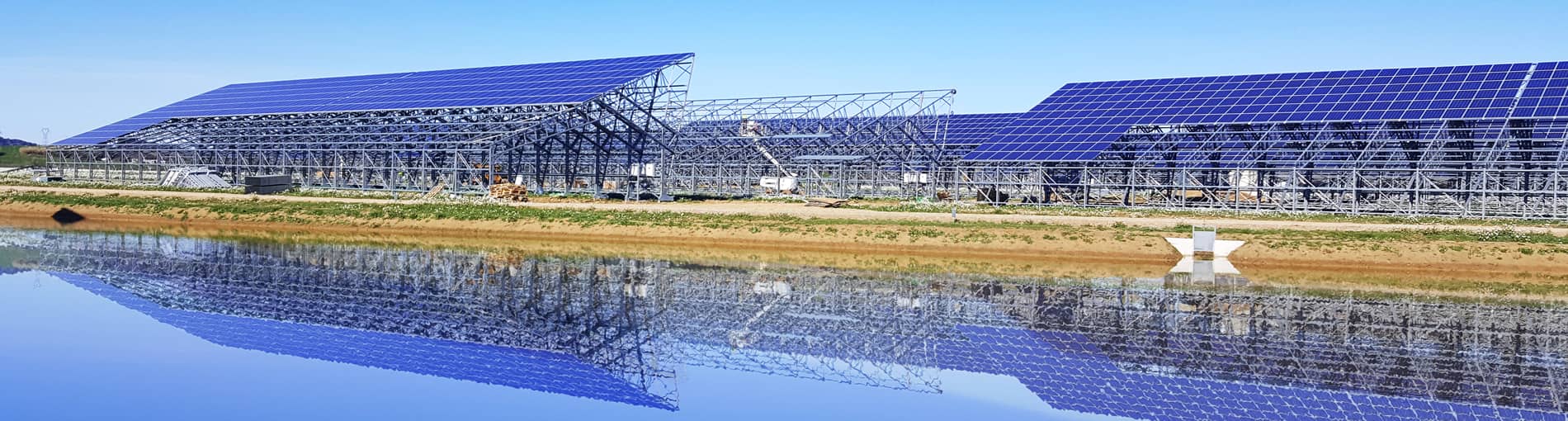
Photovoltaic power generation is a method of generating electricity that directly converts solar energy into electrical energy using solar cells. Photovoltaic power generation is the main form and direction of large-scale utilization of solar energy.
The first solar photovoltaic station in China was successfully built and officially put into operation for power generation on October 8, 1985 in Yuanzi Township, Yuzhong County, Gansu Province. This solar photovoltaic device consists of 224 polycrystalline silicon photovoltaic cells, a frame, a battery pack, a DC/AC exchanger, and a power supply control system. It has a rated power of ten kilowatts and is currently equipped with 286 twenty watt fluorescent lamps, which can provide lighting for more than 130 farmers and 14 units. Due to the use of polycrystalline silicon photovoltaic panels to convert absorbed solar radiation into electrical energy and store it in batteries, power can still be supplied even after six or seven days of continuous shade.
The large-scale photovoltaic power generation in China started to develop in 2002 and entered a rapid growth stage in 2009. After the introduction of the national grid electricity pricing policy in 2011, it added another boost to the development of photovoltaic power generation. As of 2017, the newly installed capacity of photovoltaic power generation in China reached 53.06 GW, a year-on-year increase of 53.62%, ranking first in the world.
With the continuous deepening of research and development efforts in the photovoltaic industry and the continuous improvement of production processes, the energy consumption of photovoltaic products will continue to decrease, efficiency will gradually improve, and costs will continue to decline. In addition, the introduction of carbon peak and carbon neutrality policies has pushed the energy storage industry to a climax. The vigorous development of the energy storage industry is bound to bring a new round of great growth to the photovoltaic industry.
Photovoltaic power generation relies on solar cells to convert solar radiation into electrical energy, and the ability of solar cells to convert energy is based on the photovoltaic effect of semiconductors. The photovoltaic effect, also known as the photovoltaic effect, refers to the phenomenon in which a semiconductor generates an electromotive force when exposed to light.
The main specific principle of photovoltaic power generation is the photoelectric effect of semiconductors. When a photon shines on a metal, its energy can be fully absorbed by an electron in the metal. The energy absorbed by the electron is large enough to overcome the internal gravity of the metal and do work, escaping from the metal surface and becoming a photoelectron. Silicon atoms have four outer electrons. If an atom with five outer electrons, such as a phosphorus atom, is doped into pure silicon, it becomes an N-type semiconductor; If atoms with three outer electrons, such as boron atoms, are doped into pure silicon to form P-type semiconductors. When P-type and N-type are combined, a potential difference is formed at the contact surface, forming a solar cell. When sunlight shines on the P-N junction, holes move from the P region to the N region, and electrons move from the N region to the P region, forming an electric current.